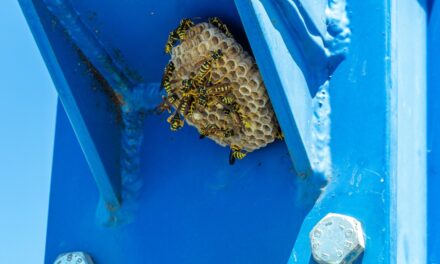

Finding a buzzing colony on your porch or under your eaves can be a problem for millions of homeowners across the country. Even though paper wasps like the Northern paper wasp are elite hunters that protect gardens from caterpillars and beetle larvae, their proximity to human activity could lead to unnecessary risks if you don’t act quickly. If a colony is built near a doorway or high-traffic area, homeowners should remove wasp nest threats as soon as possible to prevent painful stings and potential allergic reactions.
Perhaps many people are unaware, but wasps and bees are responsible for more annual human fatalities than snakes or spiders, mostly due to anaphylactic shock. That is why people must react fast to solve the problem, but there is no need to live in fear. By understanding wasp biology and following safe methods, you can effectively manage these flying insects. Here you will find a four-step process guide to safely remove wasp nest threats, once and for all.
How can you safely remove wasp nest locations near your property?
Understanding wasps behavior is critical to start removing potential threats near your property. As not all wasps are the same, you will need to start by identifying the type of wasp and nest architecture that you are dealing with. This will determine how you should approach them.
Step 1: Identify the wasp and nest type before you attempt to remove wasp nest residents
There are different types of social wasps known as paper wasps, hornets and yellowjackets:
- Paper Wasps (Polistes): These wasps usually build single-layered and open-faced nests where hexagonal cells are usually visible from below. That’s why some people call them “umbrella wasps”. Paper wasps are commonly less aggressive and they could sting only when feeling attacked or if their nest is touched.
- Hornets and Yellowjackets: Compared to paper wasps, these species build more complex nests enclosed in a thick, paper-like envelope that looks like a football-shape. Since yellowjackets often nest underground or in wall voids, dealing with them could be more dangerous. Therefore, is usually recommended to contact professional help to avoid potential risks.
After you have analyzed which type of wasp had been nesting near your property. Now its time for you to know when is the best time to eliminate the wasp nest and exactly how to do it. Remember that knowing the species is vital because social wasps are protective, but dealing with paper wasps could be easier compared to hornets and yellowjackets.
This is the best time to remove wasp nest residents
Timing is everything when homeowners are planning to remove wasp nest hazards without getting stung, and here we will explain you why.
Step 2: Choose the right time and conditions to remove wasp nest residents
According to evidence the most effective time for application is at night. Most Integrated Pest Management (IPM) researchers agree that during the day, many wasps are out in the field searching for nectar or prey. Thus, if you plan to remove the nest during daylight, returning wasps will be confused and aggressive. While at night, most of the colony is inside the nest, and their activity levels are at their lowest.
Moreover, as wasps are heterothermic, they become less active in cooler temperatures. Even though working at night could be hard for homeowners, it is recommended to use a red-filtered flashlight as wasps can’t see red light well and are less likely to feel attacked or alerted to your presence. Working in the evening will help you remove wasp nest structures while you target the entire population at once.
How to remove wasp nest hazards with botanical sprays?
Despite wasp nests could be a safety hazard, people should know that wasps are important for the environment. Wasps help pest control, they assist pollination while they travel , and they reduce the environmental impact and risks associated with heavy synthetic pesticide. Thus, its often preferred to use botanical sprays over synthetic ones because they use natural pyrethrins that degrade rapidly in sunlight and air, whereas synthetic pesticides can persist in the soil and environment for years.
As research from the University of Ottawa highlights these botanical options are often preferred because “the rapid breakdown of pyrethrins in the environment ensures that there are no persistent residues.”. This ensures that they do not accumulate in the food chain or lead to long-term groundwater contamination. Additionally, botanical extracts typically offer a higher margin of safety for pollinating bees and natural predators, helping a healthy ecological balance. Lastly, botanical sprays have a lower mammalian toxicity, reducing the risk of human health issues like long-term illnesses or respiratory disturbances associated with synthetic chemical exposure.
Step 3: Use the proper tools to remove wasp nest without getting stung
For a small nest of paper wasps you might need to consider the following:
- Mechanical removal (Only one queen): You can remove wasp nest threats by knocking the structure down with a long broom if you are dealing with a starting colony with only one queen. In this case, the queen will typically abandon the site and seek other location to start building.
- Botanical aerosols: To safely remove wasp nest occupants in larger colonies, homeowners could use botanical insecticides with long-range nozzles that spray up to 20 feet. These kind of sprays will allow you to maintain a safe distance while spraying the nest.
- Safety precautions: As previously mentioned always apply treatments in the evening or at night when the wasps are inactive inside the nest and let it work for 24 hours. It is vital to use a physical barrier against stragglers, as well as wear protective layers, including long sleeves, pants, and gloves.
Step 4: Prevent other wasps from coming through sanitation
Once wasp nest occupants are removed, it’s crucial to prevent new colonies from forming, as wasps are drawn to sugary resources. To achieve this, start by thoroughly cleaning the place where the nest location with soap and use specific sprays to repel wasps to eliminate pheromones that could attract more wasps to come in the future.
By following these four key steps of identification, timing, use of proper tools, and sanitation, it is possible for homeowners to effectively address wasp nest issues without the risk of painful stings.